Australian Owned Business

Can You Motorise Existing Roller Blinds in Australia?
Yes — most roller blinds can be motorised.
You don’t need to replace your blinds. You just need the right motor for your tube.
That's where most people get it wrong.
A motor can fit inside the tube, but if it’s not matched properly, it will spin and the blind won’t lift.
Start Here
Identify your roller blind tube to see exactly which motors will fit.
How to Choose the Right Motor for Your Blinds
Motorising your blinds is simpler than most people think. Once you identify your tube, everything else falls into place.
🧩 Step 1 — Identify Your Tube
This determines which motors will actually fit your blind.
⚙️ Step 2 — Match the Motor
Choose a motor that’s confirmed to suit your tube and blind size.
👍 Step 3 — Install & Set Up
Replace the chain mechanism and set your limits.
Identify Your Roller Blind Tube Type
To motorise an existing roller blind, the motor must match the tube it installs inside.
Below are the most common roller blind tube types used in Australian made blinds.
Select your tube to see the motors confirmed to fit.


Acmeda S45 STD
The most common tube used in modern roller blinds. Provides excellent strength and consistent performance for everyday window sizes. Typically suitable for blinds up to around 2.4m wide, depending on fabric weight and drop. A reliable all rounder for both chain driven and motorised blinds.
Outside Diameter: 44mm

Acmeda S45 HD
A thick-wall version of the S45 designed for large blinds, heavy fabrics and long drops. Its reinforced structure reduces deflection and maintains stability across wider spans. Typically used for blinds up to around 3.0m wide, depending on fabric type and installation.
Outside Diameter: 49mm

Acmeda S60
A large diameter tube engineered for extra wide blinds and architectural window spans. The S60 provides exceptional rigidity and is ideal for installations where maximum tube stability is required. Commonly used for blinds in the 3.0–4.0m+ width range, depending on fabric weight and drop.
Outside Diameter: 60mm


Acmeda S35 STD & HD
Used in older roller blind systems before the introduction of Acmeda’s modern S40 and S45 tubes. S35 can still be motorised on very small blinds (typically under 1.2 metres wide), but because it was designed for earlier generation systems, it is standard practice to upgrade to a newer tube profile for reliable performance on wider blinds.
Outside Diameter: 33 & 34mm

L45
A true 45mm round roller blind tube commonly found in imported and some locally manufactured blinds. Although it looks similar in size to Acmeda S45 tubes, the internal profile is completely different. L45 uses a round internal shape with key slots rather than the Acmeda spline system.
Because of this, it requires a different crown and drive and is not compatible with standard S45 motor adaptors.
Outside Diameter: 45mm
What Next?
If you''ve found your tube above, click it to see the exact motors that fit.
👉No guesswork. No returns.
If you couldn't match your tube, keep reading below.
👉We'll show you what to do next.
Not every tube is suitable for motorisation — here’s what to check
Tubes That Need Replacing Before Motorising
Not every roller blind tube is engineered to handle the torque of a motor. A simple rule is:
In most cases, tubes with a wall thickness under 1 mm are not rigid enough for reliable motorisation. These lighter tubes were designed for chain operation only. When paired with a motor, they can twist, deflect, or lose limits over time, especially on wider blinds.
If your blind doesn’t match one of the approved tube types above, it should be replaced before motorisation.
Tubes that require replacement include:
-
Thin wall retail tubes
Common in off the shelf blinds. Their aluminium wall thickness is typically 0.5–0.8 mm, which cannot support motor torque. -
25–28 mm tubes
Often used in imported or budget blinds. Their small diameter and thin walls make them unsuitable for motorising. -
32–34 mm tubes with no internal profile
While they may look similar to premium tubes from the outside, they do not have the internal structure required to lock in a crown & drive effectively. -
Legacy Acmeda S35 tubes wider than 1.2 metres
Suitable only for very small blinds. For blinds over 1.2 m wide, upgrading to an S40 or S45 tube is standard practice for reliable motor operation. -
Any tube that does not match one of the recognised profiles above
Upgrading the tube ensures:
-
smooth, accurate motor operation
-
correct limit positions
-
no twisting or sagging under load
-
long-term durability of the system
-
correct fitment for Automate and Somfy motors
Upgrade to a Motor-Ready Tube Kit
-
We supply complete S45 Tube Kits, precision cut to size and matched with RB09 brackets and idler, ready for motorisation.
-
A typical 2.1 m tube upgrade is only $55.35, and when ordering your motor at the same time, all shipping is bundled into one low rate.
Not Sure Which Tube You Have? Email Us Your Photos
If you couldn’t match your tube above, just email us a couple of quick photos and the outside diameter.
We’ll confirm your tube type, tell you whether it can be motorised, and let you know which motors will fit, usually within the same day.
It’s the fastest way to get a 100% accurate answer with no guesswork.
All the info we need is already pre-filled in the email, just hit the button and attach your photos.
Tube Identification FAQ
These quick checks help us confirm your tube accurately the first time.
Do I need to remove the blind?
Yes. Remove the blind from the brackets and take off the non-chain end (idler) so the tube end is clearly visible.
What do I need to measure?
Measure the outside diameter of the tube.
What if my tube doesn’t match the profiles above?
It will likely require upgrading before motorisation. Most residential upgrades move to an S45 system for reliable performance.
Do off the shelf or budget blinds work?
Some do, but many use thin-wall tubes (under 1 mm) that aren’t suitable for motorisation.
Why We Check Your Tube First
Every roller blind motor needs to match the tube it sits inside.
If the tube type isn’t identified correctly, the motor might slip, stall, or not turn the blind at all. That leads to returns, frustration and wasted time.
Checking your tube first means:
-
you get the right motor the first time
-
your blind runs smoothly and quietly
-
the install is easy and stress-free
-
there are no compatibility surprises
We specialise in retrofitting motorised roller blinds across Australia and have motorised thousands of existing blinds.
We work with the most reliable systems on the market , Automate and Somfy, and every recommendation we give is based on long term performance, not guesswork.
Want to understand how motorisation actually works?
You don’t need to know this to choose a motor, but if you’re curious, here’s a simple breakdown of how the tube, crown, drive and brackets all work together.
How a Motor Actually Turns a Roller Blind
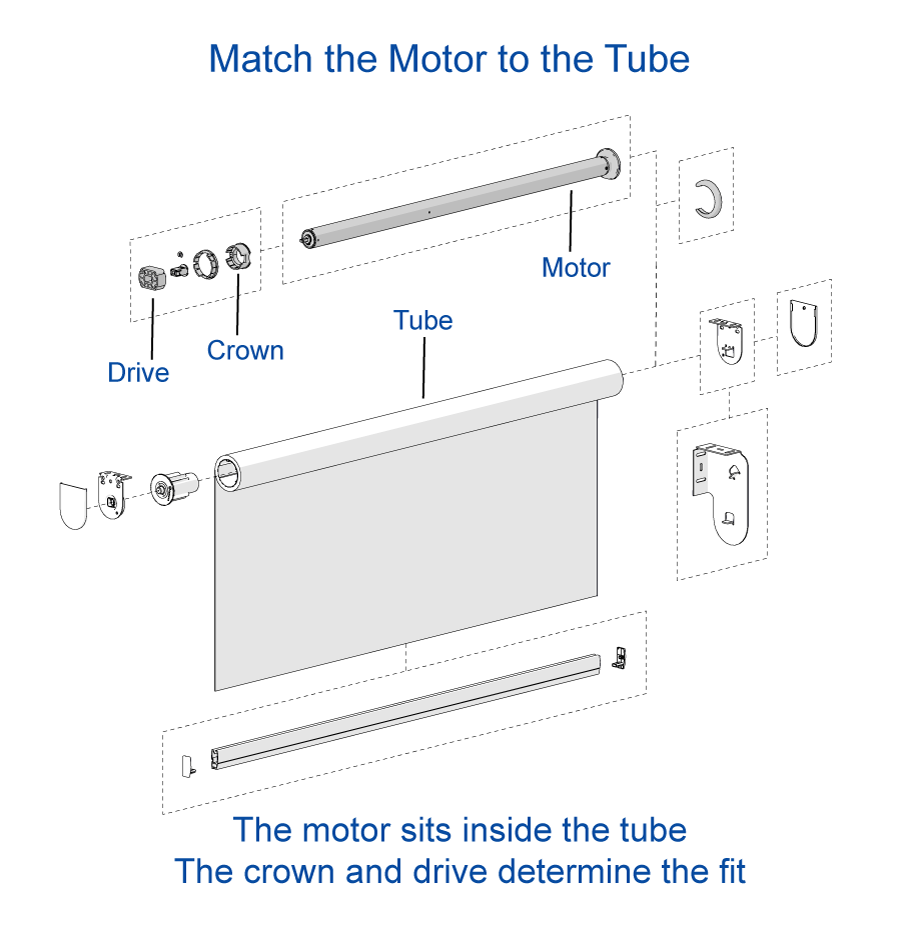
A roller blind motor sits inside your tube and turns it using two key parts, the crown and the drive.
When the crown and drive match your tube, everything works smoothly. If they don’t, the motor will spin but the blind won’t move.
Your existing brackets often work fine too, as long as the motor head fits the bracket shape so the motor sits straight and centred.
The Crown & Drive — The Most Important Parts of Retrofitting
The Drive
The drive connects to the end of the motor and locks into the internal profile of your tube. This is the piece that actually turns the blind.
The Crown
The crown sits around the motor and inside the tube, keeping everything aligned. It stops the motor from twisting or sagging inside the tube during operation.
If either one is wrong:
-
the motor spins
-
but the tube doesn’t
-
and the blind doesn’t move
This is the number one cause of “the motor is broken” complaints, when the real issue is simply a mismatched crown/drive.


Why Tube Size and Internal Profile Matter
All roller blind tubes look round from the outside.
Inside, the story is different. Tubes can have:
-
flats
-
ridges
-
grooves
-
cut-outs
-
multi-step profiles
Your motor’s crown and drive must match both:
-
Tube diameter, and
-
Tube’s internal profile
A perfect match = reliable operation.
A poor match = slipping, stalling, grinding or no movement at all.
Brackets & Idlers — The Final Piece of the Puzzle
Your existing brackets usually work perfectly if they match your blind’s tube system.
The only time you need to think about brackets is when replacing the motor-side bracket.
If that happens, it’s best to replace:
-
both brackets
-
and the idler
This is because brackets and idlers are designed as a matched set.
Mixing old and new can cause alignment issues that affect smooth operation.
It’s not about strength, it’s about keeping the motor and tube perfectly straight.
🧩 That’s How the Hardware Works
Once you understand how the crown, drive, tube and brackets work together, motorising an existing roller blind becomes straightforward, as long as you start with the correct tube type.
From here, the only remaining decisions are:
-
How much lifting force (torque) your blind requires
-
How you want to power the motor
-
How you want to control it
Let’s look at those next.
🔌 Using Zigbee?
Motor torque (Nm) refers to the motor’s lifting force.
Higher torque helps lift:
-
Heavier fabrics
-
Longer drops
-
Blinds with greater fabric weight
However, torque does not increase tube strength.
If a blind is very wide and the tube begins to flex or deflect, installing a higher torque motor will not solve the problem.
In those cases, the correct solution is upgrading to a stronger tube profile.
Torque affects lifting performance.
Tube strength affects structural stability.
Both must be considered when motorising an existing roller blind.
Rechargeable vs 240V Motors
Roller blind motors are typically powered in one of two ways: rechargeable or 240V hardwired.
Rechargeable Motors
Rechargeable, also known as wirefree motors contain an internal lithium battery and are ideal for retrofitting existing blinds. They do not require an electrician and are usually recharged every 6–12 months, depending on usage.
240 Volt Motors
240V motors connect to mains power via a cable tail, which must be installed by a licensed electrician. The motor itself fits into the tube like any other motor and does not require electrical installation. They are commonly used in new builds, renovations, short term rentals or higher cycle applications where ongoing charging isn’t preferred.
The correct choice depends on your installation type, usage frequency, and access to power.
Each compatible tube page will guide you on which power type is typically used for that tube.
How Roller Blind Motors Connect (RF vs Zigbee)
All motors turn the tube the same way.
The difference is how you control them.
Most roller blind motors use one of two wireless systems:
-
RF (Radio Frequency)
-
Zigbee
🔘 RF (Radio Frequency — Automate ARC & Somfy RTS)
RF stands for Radio Frequency — a direct wireless signal (commonly 433 MHz in Australia) used to send commands from a remote or hub to the motor.
-
Works straight out of the box with a remote
-
Does not require Wi-Fi or internet
-
Reliable, simple, and widely used
👉 Systems like Automate ARC and Somfy RTS both use RF.
You can also make RF motors “smart” by adding a hub:
-
Control via app
-
Voice control (Google, Alexa, Siri)
-
Automations and timers
If you’re unsure how hubs work, read:
👉 Why Some Smart Homes Need More Than One Hub (And Why That’s Not a Problem)
🔘 Zigbee
Zigbee is a smart home protocol that creates a mesh network, where devices communicate through a central hub.
-
Requires a compatible Zigbee hub
-
Designed for full smart home integration
-
Works best alongside other smart devices (lights, sensors, plugs)
Unlike RF, Zigbee motors:
-
Do not work independently with just a remote
-
Rely on a powered hub and network to operate
If you're not sure what the difference is, read:
🤔 Which Should You Choose?
-
Want something simple, reliable, and that still works with a remote if your Wi-Fi or hub goes down? → RF (Automate or Somfy RTS)
-
Want everything running through one app and one ecosystem (lights, plugs, sensors, blinds)? → Zigbee
-
Both systems can connect to platforms like Google Home, Alexa, and Apple HomeKit using the right hub.
-
The difference isn’t compatibility — it’s how your system is set up and controlled.
Using Zigbee?
If you're planning to integrate your blinds into a Zigbee based smart home, make sure your motor matches your hub ecosystem.
For example:
-
Somfy Zigbee motors require the Somfy TaHoma hub
-
They do not pair with Smart Life or Tuya hubs
Always confirm hub compatibility before ordering.
✅ That’s Everything
Motorising an existing roller blind comes down to one thing: identifying the correct tube.
Once the tube is confirmed:
-
The motor slides straight in
-
The crown and drive match correctly
-
Your brackets usually remain the same
-
Power and control are simply personal preference
There’s no guesswork when the tube is identified first.
Select your tube type below and we’ll show you exactly which motors fit.